Author: Ethan Publish Time: 2026-09-18 Origin: Milestone

Hand tooling transforms blank leather into three-dimensional wearable art
IN THIS ARTICLE
Hand-tooled leather isn't stamped or pressed—it's carved by hand into dampened vegetable-tanned hides, one deliberate cut at a time. A craftsperson uses bevelers, swivel knives, and shaders to push patterns into the grain, creating depth and shadow that machine embossing can never replicate. Stamped leather relies on hydraulic force and prefab dies. Hand tooling relies on pressure, patience, and a steady wrist.
This technique has deep roots in the American West, where saddlemakers and boot artisans needed durable, personalized gear that could survive hard use and still tell a story. That same craft now shapes a distinct category of hand tooled leather bags—pieces that marry frontier heritage with modern carry needs, transforming practical carryalls into collector's items. In this guide, we'll walk through the fundamentals of the tooling process, then explore how Western design language elevates everyday bags into wearable art.
The art of hand tooling begins with a single requirement: vegetable-tanned leather. Unlike chrome-tanned hides, vegetable-tanned leather absorbs water readily and holds impressions without springing back—qualities that make it the only viable canvas for carved designs. This tooling-grade leather is thicker, denser, and ages with a warm patina that deepens the carved shadows over time.
The process itself is deceptively simple in outline, yet demands years of practice to master. First, the leather is dampened—not soaked—until it reaches a pliable, clay-like state known as "casing." The artisan traces a pattern onto the surface using a stylus, leaving faint guidelines. Then comes the swivel knife, a blade that pivots as it cuts shallow beveled lines into the leather, outlining each petal, leaf, or geometric motif. These cuts define the composition's skeleton.
Next, beveling tools are pressed along the cut edges to create depth. One side of each line is pushed down, the other left raised, forming ridges that catch light. Backgrounding tools then texture the negative space—pebbled, crosshatched, or stippled—so the main design lifts visually from the surface. Finally, shading stamps add gradients of shadow, transforming flat cutouts into three-dimensional reliefs.
What makes each tooled leather bag unique is the human element. No two strikes carry identical pressure, angle, or rhythm. One artisan's hand may favor deeper bevels; another's might lean into tighter stippling. Even the same craftsperson working on two identical patterns will produce subtly different results—a variance that machines, with their algorithmic precision, can never replicate.
The leather records every hesitation, every confident strike, every shift in grip. It's this imperfect consistency that transforms a blank hide into a signed work of art, one hammer blow at a time.
Beveling forms the foundation of dimensional leatherwork. The craftsperson uses a beveling tool—typically angled at 30 to 45 degrees—to press down the edges of carved lines, creating a visible border that separates the design from the background. This single motion transforms a flat incision into a raised, sculptural element. The bevel catches light differently than the surrounding surface, which is what gives hand tooled western bags their tactile, three-dimensional quality.
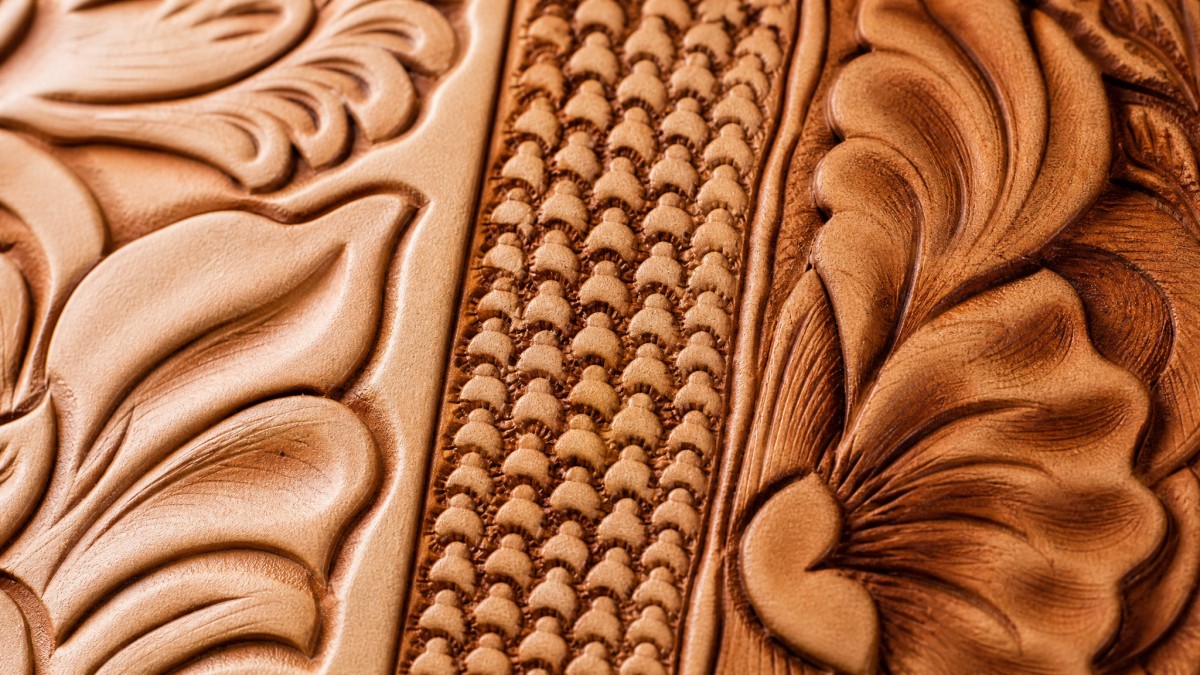
The three core techniques that give hand-tooled leather its signature depth
Backgrounding adds textural contrast by stamping or matting the recessed areas around the main motif. Artisans use small geometric stamps, pebble textures, or crosshatch patterns to "push back" negative space, making the beveled design appear to float forward. On a western handbag, backgrounded tooling might surround a floral scroll or a rope border, creating depth without adding bulk.
Where backgrounding creates stark contrast, shading introduces gradients and soft transitions. Using a spoon-shaped modeling tool, the leatherworker burnishes the leather in gentle, overlapping strokes—pressing harder near shadows and lighter toward highlights. This technique mimics the way light falls on a petal or the curve of a saddle strap. It's a subtle move, but it separates competent tooling from masterful work. Combined, beveling, backgrounding, and shading give western leather bags their signature richness—a look that feels handmade because it genuinely is.
From the ancient Sumerians who pressed patterns into leather armor to the Medieval European guilds that carved ornate book covers, tooling has always been humanity's way of turning hide into heirloom. But it was the American West—vast, unforgiving, and deeply romanticized—that transformed this craft into a cultural signature.
Cowboys didn't just need saddles; they needed proof of skill and identity. Saddle makers in Texas, Montana, and New Mexico became storytellers, etching floral scrolls that mimicked the wild roses clinging to canyon walls, basket weave patterns borrowed from Native American craftsmanship, and oak leaves with acorns symbolizing strength and endurance. Every motif carried weight. A well-tooled saddle announced its rider's status before a single word was spoken.
That same artistry didn't stay on horseback. As the frontier closed and Western iconography seeped into fashion, tooled leather migrated from tack shops to wardrobes—and eventually, to handbags. Modern western leather bags inherit this lineage directly. The floral cascades on a crossbody? Descendant of 1880s saddle skirts. The geometric basket weave on a tote's gusset? Rooted in rawhide braiding techniques perfected over campfires.
Today, whether you're sourcing from a manufacturer that respects this heritage or simply admiring a finished piece, you're holding a fragment of frontier history. The Western tradition didn't vanish—it evolved, one stamped petal at a time, proving that some crafts are too visceral, too connected to identity, to ever fade.
Tooled leather bags bring centuries-old decorative technique into everyday carry. The most common Western styles—crossbody bags, totes, and satchels—feature tooled panels on the flap, front pocket, or body, turning functional pieces into wearable art. A crossbody might showcase a galloping horse or geometric border, while a structured tote displays symmetrical floral motifs across its face.
Beyond aesthetics, tooling offers a structural advantage. The stamping and carving process compresses and stiffens the leather, creating natural rigidity without heavy lining or internal frames. This is why many vegetable-tanned bags rely on tooled panels to hold their shape—the work itself reinforces the material. For manufacturers, this means fewer components and a cleaner construction process. For users, it translates to bags that maintain their silhouette even when empty.
That structural foundation becomes even more expressive through color. Natural tan leather—left undyed after tooling—develops a rich patina over time, darkening where oils from hands settle into carved grooves. Dark brown finishes highlight the depth of stamped designs, while black tooled leather purses offer high contrast, making floral or Western motifs pop against the inky background. Each finish ages differently: tan brightens and burnishes, brown deepens to near-mahogany, and black shows wear along raised edges, revealing the lighter leather beneath.
Western leather bags often combine multiple tooled elements—a carved yoke on the flap, braided accents along the edges, and concho hardware as closures. This layering creates a tactile, dimensional surface that distinguishes hand-tooled pieces from smooth or embossed alternatives. The result is a bag that carries both visual weight and functional durability, rooted in craft traditions that predate modern manufacturing.
Given how much tactile and structural detail goes into tooled work, spotting genuine hand-tooled craftsmanship isn't difficult once you know what to look for—and it matters, especially when investing in pieces like a black tooled leather purse where authenticity affects both longevity and value.
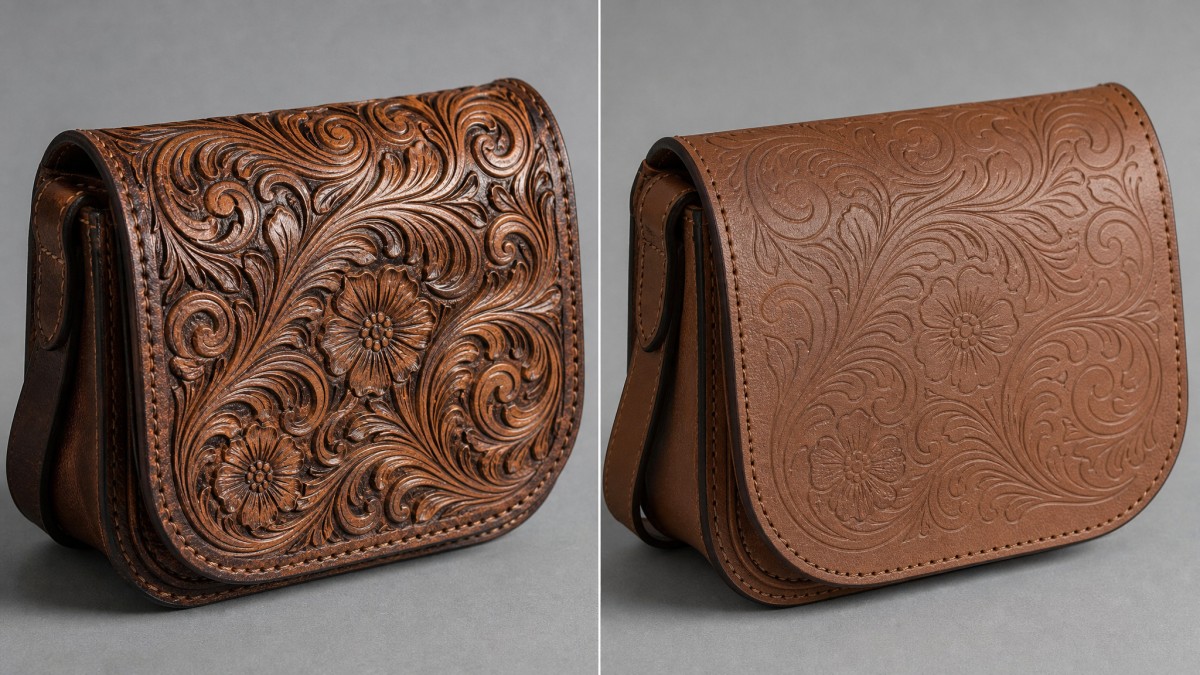
Authentic hand tooling shows depth variation and slight imperfections that machines cannot replicate
Start with depth variation. Run your fingertips across the tooled surface. You should feel raised beveled edges around each carved line, not just texture. Machine stamping compresses leather uniformly; human hands bevel, cut, and carve at varying angles, creating subtle inconsistencies in depth. These "imperfections" are the signature of real artisan work.
Next, examine the backside of the leather. Authentic hand tooling penetrates the full thickness of the hide—flip the bag over (or check an interior seam allowance) and you'll see faint impressions mirroring the front design. Stamped or embossed leather rarely shows through. The pattern sits only on the surface.
Finally, look for slight irregularities in repeat motifs. A floral pattern hand-carved five times won't be identical each time. If every leaf is pixel-perfect, it's likely machine-pressed. Real tooling carries the wobble of human pressure, the occasional overstrike, the trace of a craftsperson's grip.
These markers aren't flaws—they're proof. When you're evaluating Western-style bags at scale or sourcing inventory, this tactile literacy separates heirloom-quality leather from mass-market mimicry.
Once you can distinguish authentic tooling from stamped imitation, the pricing structure makes immediate sense. A hand-tooled western bag commanding $400 to $800 isn't expensive—it's priced for what it is. Each piece demands 8 to 20 hours of carving, beveling, and finishing, depending on the intricacy of the floral or geometric pattern. Compare that to a stamped bag at $40 to $150, die-cut in minutes, and the gap becomes logical.
The real divergence shows up years later. Vegetable-tanned leather—standard for tooling—develops a burnished patina as natural oils migrate through the fiber. The grain tightens. Surface scratches blend into the texture rather than screaming "damage." A well-maintained tooled bag at the ten-year mark often looks richer than it did new, while mass-production alternatives crack along fold lines or shed their topcoat.
For B2B buyers sourcing western-style collections, this longevity translates to fewer warranty claims and stronger brand positioning. Customers paying $500 expect heirloom behavior, not planned obsolescence. That expectation—and the artisan hours baked into every square inch—justifies the premium and reshapes how retailers frame value in their own merchandising.
Given the investment and longevity potential, proper maintenance becomes essential. Preserve the carved narrative by conditioning your tooled leather every 6–12 months with a high-quality leather conditioner—this keeps the hide supple without drowning the raised contours. Pat the product lightly over the surface rather than saturating it. Hand-carved details can blur permanently if waterlogged, washing out the crisp lines a craftsperson spent hours achieving.
Avoid water exposure whenever possible. If your bag gets caught in rain, blot immediately with a soft cloth and let it air-dry away from direct heat. Radiators and hairdryers can crack the grain and collapse the tooled relief.
Store in a breathable dust bag—never plastic—so air circulates around the carved depth. Plastic traps moisture, inviting mildew that eats into the pattern. Stuff the interior with acid-free tissue if the bag will rest unused for weeks; this prevents the tooled surface from collapsing inward and losing its dimensional character. Treat the piece like archival leatherwork, because that's exactly what it is.
Hand-tooled leather represents more than skilled craftsmanship—it's wearable art that honors centuries of artisan tradition while serving modern function. Each tooled leather bag carries the maker's hand in every carved line, bridging heritage techniques with everyday utility.
At Milestone, we build our wholesale partnerships around this same commitment to authentic artisan methods, ensuring that B2B clients receive products grounded in time-tested leatherwork rather than mass-market shortcuts. For retailers and distributors seeking pieces that stand apart, hand-tooled bags offer a multi-generational value proposition: they don't just survive trends—they outlast them, aging into heirlooms rather than landfill candidates. In a world chasing disposable speed, a hand-carved western bag remains a tangible investment in permanence.
Ready to start your custom project?
Expert insights on care, styling, and manufacturing.
Authentic hand tooled leather is carved and stamped entirely by hand using specialized tools like swivel knives, bevelers, and stamps. Machine stamping creates repetitive patterns quickly but lacks the depth, detail, and unique character of genuine hand tooling. Each hand-crafted piece shows slight variations that prove its artisan origin, while machine work appears identical across items.
Hand tooled leather costs more because each piece is individually carved by hand, requiring 8–20+ hours of skilled labor per item. The artisan must master years of technique to create intricate designs, and premium full-grain hides—often the highest grade of genuine leather—are necessary since tooling reveals any imperfection. Mass production can't replicate this craftsmanship, making each piece a wearable work of art.
Hand tooling works best on vegetable-tanned leather, which absorbs water and holds crisp impressions. Chrome-tanned leather resists water absorption and won't retain tooled designs well, making it unsuitable for this technique. Professional leather crafters stick with veg-tan for all carved and stamped work.
A belt typically takes 6-12 hours to hand tool, while a wallet requires 3-6 hours. The difference comes from surface area—belts have more continuous space to carve and stamp. Complexity matters too: intricate floral patterns or custom designs add time to both pieces, regardless of size.
Proper hand tooling does not weaken leather; in fact, it can enhance durability by compressing fibers during the stamping process. The leather must be vegetable-tanned and adequately thick to handle the tooling depth. Quality matters—expert craftsmanship on premium leather ensures the piece remains strong and ages beautifully for decades.