A quilted tote worth making well.
IN THIS ARTICLE
A quilted tote sits in that sweet spot where hand-stitched charm meets the grocery-run reality of a real workhorse bag. The puffed diamonds catch light like heirloom upholstery, yet the double-layered fabric shrugs off water bottles, laptops, and that one leaky takeaway container.
In this guide, you'll build a 15" x 14" x 4" finished tote, sized for daily haul. Difficulty sits at beginner-intermediate, and most sewists wrap up in 3-4 hours from cut to topstitch.
We'll walk through fabric and batting picks, marking and stitching the quilt grid, clean bag assembly, and the small troubleshooting fixes that save a project mid-seam. Curious how this craft translates into premium goods? Take a detour through the story behind a quilted leather handbag before we scale things up.
If you're sewing quilted totes for your brand at volume, or need bulk quilted bag production, reach out to our team.
Every quilted tote starts with the same shortlist of components, and skimping on any one shows up in the finished bag. The core supply set:
For the outer shell, quilting cotton is the easiest to sew and takes small-scale prints well, but it drapes limp without heavy batting behind it. Canvas in the 8–10oz range holds shape, hides needle marks, and suits solids or medium prints that read as tailored. Linen sits between the two, soft to the hand with a subtle slub, and prefers midscale patterns because busy prints get lost in the weave. A rule that saves rework: match pattern scale to bag size. Micro-prints for pouches, medium florals or geometrics for totes, larger repeats only when panels are big enough to show one full motif.
Batting decides the structure. Cotton batting (around 3-4 oz low-loft) gives a soft, hand-quilted drape, the default for slouchy market totes. Fusible fleece is lighter and easier to handle, well suited to medium totes that need shape without stiffness. Soft & Stable by ByAnnie is a foam-core layer prized for standing upright on its own; bag makers in the ByAnnie community note that swapping Soft & Stable back to fusible fleece is the quickest way to soften a design that turned out stiffer than expected. Foam interfacing such as Pellon Flex-Foam sits in the same family but fuses directly to fabric, cutting a basting step out of structured commuter totes and laptop carriers.
If you are sourcing quilted totes at scale for your brand, or need bulk quilted bag production with consistent materials and finish across a full run, our team at Milestone can quote and sample. Reach out to talk through your specs.
Before the machine hums, get your numbers right. For a standard medium tote (roughly 15" wide × 14" tall × 4" deep), cut two body panels at 16" × 15" from your quilted outer fabric, and mirror those dimensions for the lining. Straps run 4" × 24" as cut, folded and topstitched down to a clean 1" finished width. That gives you a handy rule of thumb: strap width equals finished width times four, accounting for the double fold plus seam allowance.
Boxed corners keep the base flat. Mark a 2" square at each bottom corner of the body and lining panels, then trim before assembly for a 4" gusset.
Prep matters more than most sewists admit. Pre-wash cotton or canvas before quilting to shrink out the surprises, since a bag that puckers after its first wash is a bag returned. Line up the grainline parallel to the selvage on every panel to stop twisting after use. If your outer fabric carries a directional print (stripes, florals, logo repeats), lay all pieces facing the same way before you cut. Nothing looks more amateur than an upside-down motif on a finished tote.
If you're scaling past a few samples and need bulk quilted bags sewn to spec for your brand, reach out to our team at Milestone. We can quote quantities, lead times, and custom sizing.
Before a single stitch goes down, decide on the pattern. It sets the entire personality of the tote.
Once the pattern is chosen, baste the outer fabric, batting, and lining sandwich together with curved safety pins or a temporary spray adhesive, spacing pins roughly a palm's width apart to stop the layers from shifting.
Mark your lines lightly with a hera marker, chalk wheel, or air-erasable pen. For a diamond grid, draw the first 45-degree line corner to corner, then space parallel lines evenly, usually 1 to 2 inches apart depending on the loft you want.
Swap your standard presser foot for a walking foot. It feeds top and bottom layers at the same rate, preventing the puckering and drag that ruins geometry on thicker sandwiches.
Set the stitch length between 2.8 and 3.2 mm. Anything shorter perforates the batting; anything longer loses definition. Choose a 40-weight polyester thread for durability, or cotton if you want a matte, natural finish that photographs well.
Start stitching from the center of the panel and work outward. This pushes excess ease toward the edges instead of trapping bubbles in the middle.
If you need quilted totes sewn in bulk for your brand, or you're sourcing quilted bags at production volume, feel free to reach out to our team.
Now the fabric pieces come together. Start by boxing the corners of both the outer shell and the lining. Pinch each bottom corner flat, align the side seam with the bottom seam, then measure 2 to 3 inches from the point and stitch straight across. Trim the excess triangle. This single step transforms a flat pouch into a structured tote with a proper flat base, and if you'd like a deeper walkthrough of that base construction, this guide on creating a clean flat bottom for tote bags covers the geometry in detail.
Next, position the straps on the outer bag. Mark their placement symmetrically, usually 4 to 5 inches from the side seams, and baste them in place with raw edges aligned to the top opening. Reinforcement here is non-negotiable. Straps carry the full weight of the bag, so every attachment point should be locked down with an X-box stitch: sew a rectangle where the strap meets the bag, then cross two diagonals inside it. For webbing or thicker leather straps, add bar tacks, a tight zigzag that concentrates thread density at the highest-stress zones.
Now assemble the lining the same way you built the shell, minus the straps, and leave a 4-inch turning gap along one lining side seam. Slide the outer bag inside the lining, right sides together, matching side seams and top edges. Stitch all the way around the opening. Pull everything through the turning gap, push the lining down inside, and press the top edge flat.
Finish with topstitching around the opening, about 1/4 inch from the edge. That single line of stitching closes the turning gap, locks the lining in place, and gives the bag its crisp, retail-ready silhouette.
If you're developing a quilted tote line for your brand or need reliable bulk production of quilted bags, reach out to our team at Milestone. We'd be glad to discuss samples, materials, and MOQs tailored to your project.
Even seasoned makers hit snags with quilted totes. Here are the five issues that trip up most sewists, along with the fix that actually works.
For multi-layer sewing, swap to a 90/14 or 100/16 topstitching needle, lengthen your stitch to 3.0–3.5mm, and slow the machine down. A walking foot or dual-feed setting keeps the sandwich from shifting under the presser foot.
Care matters just as much as construction. For everyday marks, spot clean with a damp microfiber cloth and mild soap. Hand wash in cool water when the bag needs a deeper refresh, then press out moisture with a towel, stuff the interior with dry cloths, and let it air dry flat to hold its shape.
If you're sourcing quilted bags at scale or need a manufacturing partner to sew your brand's designs in bulk, reach out to our team at Milestone. We'll walk you through samples, materials, and MOQ options.
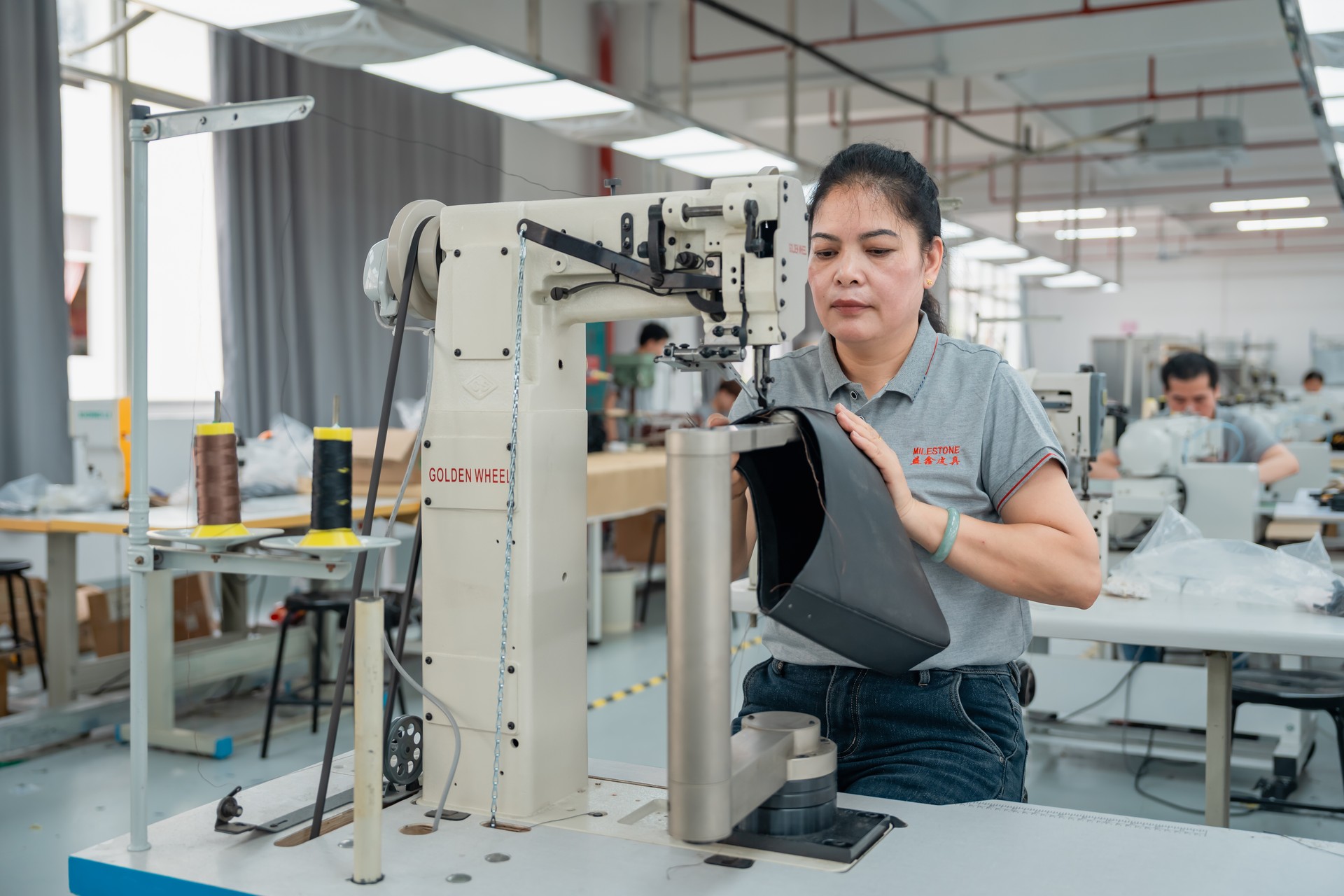
Sewing one quilted tote on a Sunday afternoon is charming. Sewing fifty for a boutique launch is a different animal entirely. Around the 20-unit mark, home methods start showing cracks: diamond spacing drifts by a millimeter here, batting loft varies from bolt to bolt, and thread tension shifts as your domestic machine heats up. By unit 50, those small drifts stack into visible inconsistency across your product line, and returns start creeping in.
Consistency is only half the pain. Sourcing quilt-grade cotton and polyester batting in small runs means paying retail markups, and hand-guided topstitching rarely survives the shoulder-strap stress test that customers put on a tote loaded with a laptop and a water bottle.
Factory-side, the workflow looks completely different. Pre-quilted panels arrive on rolls, already stitched in uniform diamond or channel patterns. Roll-to-roll cutting with digital knives drops fabric waste to single-digit percentages. Handle attachments get reinforced bar tacks rather than a nervous back-stitch, and seam allowances are locked in by templates rather than pencil marks.
For a scaling boutique, the realities to plan around are MOQs that typically start between 300 and 500 units per SKU, sampling lead times of two to four weeks, and material sourcing where quilted face fabrics, linings, hardware, and webbing each come from separate vendors that a good factory already has vetted. That coordination is where most first-time brands get burned, and it's exactly the layer a seasoned tote bag production partner is built to absorb.
If you're sewing quilted totes for your brand or need bulk quilted bag production, reach out to us and we'll help you move from prototype to shelf.
Quality in a quilted tote comes down to three habits you now have in your toolkit: choosing the right fabric and batting, holding quilting discipline (consistent stitch length, gentle tension, straight channels), and reinforcing every stress point at handles, corners, and the base. Get those right and the bag will hold its shape through years of daily carry, not just the first photo op.
So thread the machine, cut with confidence, and finish that tote. Your first one teaches you more than any tutorial can.
If you're a brand scaling past the sewing table, that's where we come in. Milestone runs bulk quilted bag production for labels across the US, EU, and AU, handling everything from pattern grading to finished cartons. Need consistent runs of custom quilted totes for your next collection? Reach out to our team and we'll map out materials, MOQs, and lead times together.
Ready to start your custom project?
Expert insights on care, styling, and manufacturing.
Low-loft cotton or cotton-blend batting (around 3-4 oz weight) is the sweet spot for quilted totes. It gives structured definition to the quilting lines without turning the bag into a stiff board. Avoid high-loft polyester, which puffs too much, and skip fusible fleece alone if you want real body and drape.
For the polished construction in this guide, keep a lightweight fusible interfacing at the stress points, even when the outer fabric is canvas. Canvas already has body, so you can skip a full layer across the panels, but a strip of fusible interfacing at the handle attachments, pocket openings, and bag mouth is what keeps those areas from stretching and softening over time. Skip it entirely only for casual, slouchy totes where a relaxed shape is the goal.
Trim the seam allowances inside the boxed corner before turning to reduce bulk that causes puckering. Press seams open, align the side and bottom seams precisely so they nest, and pin through all layers before stitching. A walking foot also helps feed the quilted layers evenly, keeping corners crisp rather than bunched.
Most sewists skip quilting the lining and keep it flat, which reduces bulk and makes the interior smoother for sliding items in and out. If you want extra body or a reversible look, a lightly quilted lining works, but pair it with thinner batting so seams stay crisp and turning corners doesn't get bulky.