Author: Ethan Publish Time: 2026-08-14 Origin: Milestone

What is microfiber leather?
IN THIS ARTICLE
Microfiber leather — sometimes spelled microfibre leather — is a synthetic material made by bonding ultra-fine polyamide fiber bundles with a polyurethane (PU) coating, engineered to replicate the look, hand-feel, and durability of animal hide.
The manufacturing process is more precise than it sounds. As a Google Patents filing on superfine leather production explains, the fiber structure begins as a sea-island composite: soluble polyester (the "sea") is dissolved away under alkaline or solvent conditions, leaving tightly packed polyamide microfibers embedded in PU — a structure that mimics the fibrous architecture of genuine leather at a microscopic level.
Why does this matter right now? Sourcing pressures, sustainability mandates, and raw-material cost volatility are pushing brands across fashion, automotive, and accessories to rethink their material stack. This guide covers microfiber leather's composition, quality tiers, and what buyers and brands need to know before placing an order.
That fibrous architecture — the one that makes microfiber leather behave so differently from standard synthetics — starts at a scale most buyers never think about.
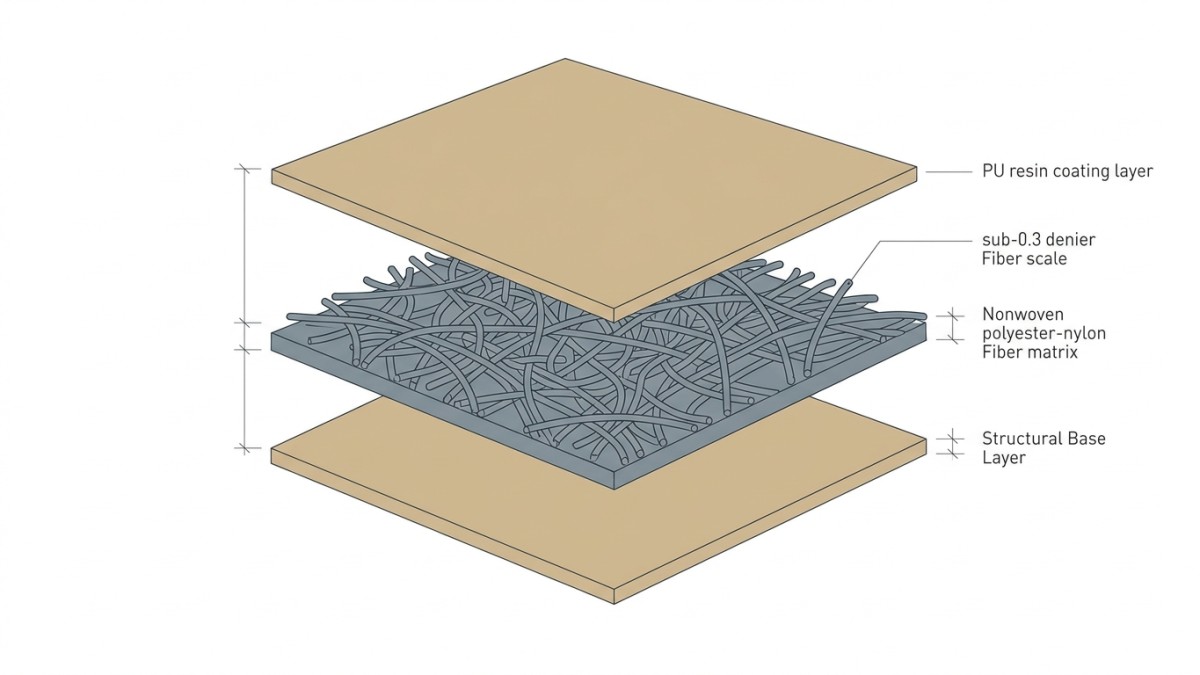
Three-layer structure diagram.
The polyester or nylon strands used in microfiber leather are sub-0.3 denier — finer than a strand of silk, and far thinner than what conventional synthetic fabrics use. Fiber fineness at this scale dramatically increases surface area within the material. That's what produces the soft hand-feel and tight, uniform grain. Polyester's role in modern manufacturing extends well beyond basic textiles; here, it's doing genuinely precise structural work.
Those ultra-fine fibers are entangled into a dense nonwoven matrix — not woven or knitted, but mechanically interlocked into a three-dimensional web that mimics the fibrous architecture of animal hide. This base layer carries the structural load: tensile strength, tear resistance, dimensional stability.
Then comes the PU resin. Applied through a wet-coating impregnation process, the polyurethane doesn't just coat the surface — it penetrates the fiber matrix, bonding individual strands while leaving microscopic voids that allow air and moisture vapor to pass through. A patent abstract describing this process notes that the result is an "ultrafine fiber bundle-myelin sheath" microstructure — the same architecture responsible for microfiber leather's close resemblance to genuine leather at the fiber level.
Knowing what the material is made of only gets you halfway there. How it's assembled — the specific sequence of extrusion, entanglement, and coating — is what determines whether the finished product holds up or falls apart.
Manufacturers begin by needle-punching ultra-fine filaments into a dense nonwoven base fabric. That base is the structural backbone of everything that follows.
From there, the process splits into two distinct coating paths. Wet-process coating impregnates the nonwoven substrate with polyurethane solution in a water bath, creating an open, porous cell structure that breathes and flexes much like split leather. Dry-process coating applies PU in controlled film layers, yielding a tighter, more uniform surface — better for high-gloss or heavily embossed finishes, but with less natural give.
The choice of process isn't cosmetic. It directly shapes tensile strength, peel resistance, and how the surface ages under daily stress.
This is where manufacturing precision becomes a supply-chain argument, not just a technical footnote. A Google Patents filing on ultrafine nonwoven leather notes that the distinctive "ultrafine fiber bundle–myelin sheath" microstructure makes it possible to predict physical and mechanical properties after coating with far greater accuracy — raising both quality consistency and resemblance to genuine leather.
For B2B buyers, that predictability translates into tighter batch-to-batch tolerances and fewer costly surprises at the QC stage.
To answer the question "is microfiber leather real leather?" plainly: no. It's a synthetic material engineered from polyurethane-coated microfiber fabric. That said, "not real" doesn't mean inferior — in several measurable ways, it outperforms both genuine leather and standard PU leather.
Here's how the three materials stack up across the criteria that actually matter to buyers and brands.
Microfiber Leather vs. Genuine Leather vs. PU Leather: Performance Comparison
| Property | Microfiber Leather | Genuine Leather | PU Leather |
|---|---|---|---|
| Durability | Excellent — resists tearing and delamination | Good, varies by hide grade | Fair — prone to peeling over time |
| Breathability | Good — fibrous structure allows airflow | Excellent | Poor — plastic-like surface traps heat |
| Water Resistance | Excellent | Poor without treatment | Excellent |
| Abrasion Resistance | Excellent — outperforms both alternatives | Moderate | Low |
| Aging / Patina | Stable; no rich patina develops | Develops character over years | Degrades; surface cracks and flakes |
| Cost | Mid-range | High (premium grades) | Low |
| Eco Profile | Better than PU; no animal byproduct | Mixed — tanning is chemical-intensive | Petroleum-based; least sustainable |
Microfiber leather wins outright on abrasion resistance and dimensional stability — critical factors for bags, upholstery, and high-contact accessories. It holds its shape without cracking grain or surface flaking, which is the most common complaint with budget PU products.
The honest trade-off? Genuine leather still holds an edge in breathability and that unmistakable aging character — the patina that deepens with use. If your product story leans on heritage and natural texture, that gap matters.
For performance-driven, cost-conscious applications, microfiber leather vs. PU leather isn't a close contest. Microfiber is simply built better.
The comparison table frames the categories. The numbers behind them explain why microfiber leather performs the way it does in real use.
Microfiber leather typically achieves abrasion resistance ratings of 100,000+ Martindale cycles — a figure that dwarfs most corrected-grain bovine leathers tested under the same conditions. Its tensile strength holds firm under repeated stress, and crucially, it resists hydrolysis: the slow chemical breakdown triggered by humidity and sweat that causes cheaper materials to delaminate and crumble from the inside out.
For wallets, handbags, and belts, these aren't abstract lab metrics. A wallet endures thousands of pocket insertions per year, rubbing against keys and coins. A belt faces constant buckle friction and moisture from body heat. A structured handbag gets dropped, overstuffed, and dragged across surfaces daily. Materials that can't survive that mechanical punishment become a liability — for the end user and for the brand whose logo sits on the lining.
On consistency, microfiber has a structural advantage over genuine leather: every panel performs identically. There are no weak spots from scarring or hide variation. The trade-off — the absence of patina — was covered in the section above. Go in knowing it, and it stops being a surprise.
Performance specs only matter if the material you receive actually delivers them. That gap — between what a supplier claims and what arrives — is where sourcing risk lives.
Not all microfibre leather is created equal, and the difference between premium and counterfeit can cost your brand dearly in returns, complaints, and reputation damage. Use this four-point checklist before committing to any supplier.
Request the denier spec in writing. Premium microfiber leather uses ultra-fine fibers measuring 0.1 denier or below. Anything coarser tends to produce a stiffer, less breathable material that mimics genuine leather poorly under stress.
Run your hand across the surface slowly. High-grade material shows a consistent, fine-grain pattern with a subtle matte depth. A glossy, plastic-like sheen — the kind that almost looks wet under fluorescent light — signals a low-quality PU coating applied over an inferior substrate. Trust your fingertips here.
Ask your supplier for a cut sample. Slice through the edge and examine the interior. Premium microfiber leather reveals a dense, fibrous cross-section — almost like felt compressed tightly. Foam-core interiors indicate budget-grade construction that cracks and delaminates far sooner.
Fold the sample sharply and release it. Quality material springs back cleanly, leaving no permanent crease. Stiff, slow recovery — or a crease that stays — points to inferior fiber bonding.
On the sourcing side, request REACH compliance documentation, SGS test reports, and ISO 9001 certification from any prospective supplier. These aren't bureaucratic formalities; they're your first filter against imitations that look right on a product sheet but fail in the field.
When people talk about synthetic leather, the conversation usually jumps straight to PU. Microfiber leather rarely gets the spotlight — and that's a mistake, especially for leather goods where daily wear is brutal.
Think about a wallet that gets shoved into a back pocket a hundred times a week, or a belt that flexes every time you sit down. PU leather handles these conditions poorly. Its topcoat peels, the edges fray, and within a year you're looking at something that resembles a molting snake. Microfiber leather behaves differently. Its nonwoven fibrous base — the same structural logic as genuine leather — distributes stress across the material rather than concentrating it at weak points.
For handbags, belts, cardholders, and small leather goods, this translates to real longevity. The surface resists scuffs without feeling plasticky. It holds stitching cleanly. It doesn't stiffen in cold weather or go tacky in heat.
This isn't a budget substitute dressed up with better marketing. When comparing microfiber leather vs. PU leather in practical applications, microfiber is the more technically sophisticated material — a premium synthetic that earns its price point through structural performance, not just surface appearance.
Material performance and sourcing quality are only part of the decision. For many brands today, the ethical and environmental profile of a material carries equal weight.
Microfiber leather's vegan, animal-free credentials are genuine — no hides, no slaughterhouses. For brands navigating ethical sourcing, that distinction matters. But the full picture is more nuanced than the label suggests.
Low-grade production is where the concerns surface. Poorly regulated facilities may use phthalate-based plasticizers or harsh solvents during the PU coating process, introducing chemicals that linger in the finished material. It's worth asking whether vegan leather is actually eco-friendly before treating "animal-free" as synonymous with "clean."
On the regulatory side, sourcing from certified manufacturers provides meaningful protection. EU REACH restrictions apply equally to imported goods and domestic production, meaning any microfiber leather product entering the European market must meet the same chemical safety thresholds — regardless of where it was made. Prioritize suppliers who can provide REACH compliance documentation. That single requirement filters out a significant share of low-quality, high-risk production.
At Milestone, microfiber leather isn't a sideline — it's a material we've worked with across hundreds of bag constructions, from structured briefcases to softshell totes. That hands-on depth shapes every production decision we make.
For brands sourcing at scale, MOQ flexibility matters. We accommodate both emerging labels testing a new line and established buyers placing volume runs, with material grading options that span entry-level performance to premium, full-grain-feel microfiber. OEM and ODM capabilities are fully in-house, meaning you can bring a finished design or start from a concept — we handle pattern development, sample iterations, and production without routing work through third parties.
The result: fewer handoffs, tighter quality control, and shorter lead times on complex orders.
Ready to discuss your next collection? Share your sourcing requirements with our team and we'll respond with material options and a tailored production proposal.
Ready to start your custom project?
Expert insights on care, styling, and manufacturing.
Microfiber leather is a synthetic material, not real leather — but it's far more sophisticated than basic plastic. It's engineered from ultra-fine polyester fibers bonded with polyurethane, mimicking leather's texture and durability. While it lacks animal hide, it outperforms many plastics in breathability, strength, and appearance, making it a legitimate leather alternative.
Microfiber leather handles daily wear remarkably well. Its tightly woven synthetic fibers resist scratches better than genuine leather, and most spills wipe clean easily due to its low porosity. With minimal care, it maintains its appearance through consistent use — making it a practical choice for high-traffic items like bags, wallets, and upholstery.
Luxury brands quietly adopt microfiber leather primarily for cost control, consistency, and ethical positioning. Unlike genuine hide, it eliminates supply chain unpredictability, delivers uniform texture across large production runs, and sidesteps animal welfare scrutiny — all while maintaining a premium feel that most consumers genuinely cannot distinguish at first touch.
Microfiber leather breathes better than genuine leather or PVC vinyl. Its fibrous structure allows modest airflow, reducing heat buildup. You'll still experience some warmth in extreme summer heat, but significantly less sweating compared to traditional synthetic alternatives. Perforated versions improve breathability further.
A few tactile and visual checks will usually reveal the truth. Real leather has irregular grain patterns, a distinct earthy smell, and edges that look raw or stitched. Microfiber leather feels slightly more uniform and plasticky at the edges. If a deal seems suspiciously cheap for "genuine leather," trust your instincts.