Author: Ethan Publish Time: 2026-08-05 Origin: Milestone

Capacity meets craft — the carryall defined.
IN THIS ARTICLE
You're browsing a supplier catalog and the label just says carryall bag — no further clarification. Is it a tote? A duffel? Something else entirely? That confusion is deliberate, not an oversight.
Unlike a crossbody or a structured satchel, a carryall isn't defined by its silhouette. Capacity and versatility are the defining traits — the bag is built to carry a lot, across a wide range of contexts. The specific shape is secondary.
This article breaks down what the term actually means in practice, which bag styles it most commonly describes, and how to narrow your options when you're sourcing or buying one.
The word carryall does exactly what it says: carry all. It describes a bag built around the premise that you shouldn't have to choose what to bring — you take everything. The term has deep etymological roots in total utility, long applied to vessels designed for maximum load without sacrificing portability.
In practice, a carryall bag tends to share a few recognizable traits: generous interior volume, a soft or semi-structured body that accommodates irregular loads, and the kind of everyday versatility that moves from a morning commute to a weekend trip without complaint. There's no single silhouette locked to the name. A wide-mouth tote, a slouchy hobo, a compact duffle — any of these can earn the label depending on how it's built and how it's used.
Luxury houses helped sharpen the market's understanding of the term. Louis Vuitton's CarryAll PM, for instance, gave the name a specific commercial anchor: refined, functional, and unmistakably intentional in its design. That kind of brand visibility pulled carryall out of generic utility-speak and into fashion vocabulary.
Today, the carry all handbag sits at an interesting crossroads — practical enough for daily use, polished enough for professional settings. That tension is exactly what makes it worth understanding before you source or stock one.
Size is the first thing to nail down. Most carryall bags fall into three practical tiers: small (roughly 12×9×5 in, 11–15L), which handles a day's essentials without bulk; medium (around 15×11×6 in, 16–25L), the sweet spot for commuters and light travelers; and large (18×13×7 in or more, 26L+), where the category starts overlapping with duffles and weekend bags. That last tier is where carryall bag territory gets genuinely roomy — think gym kit, a laptop, and still room for a jacket.
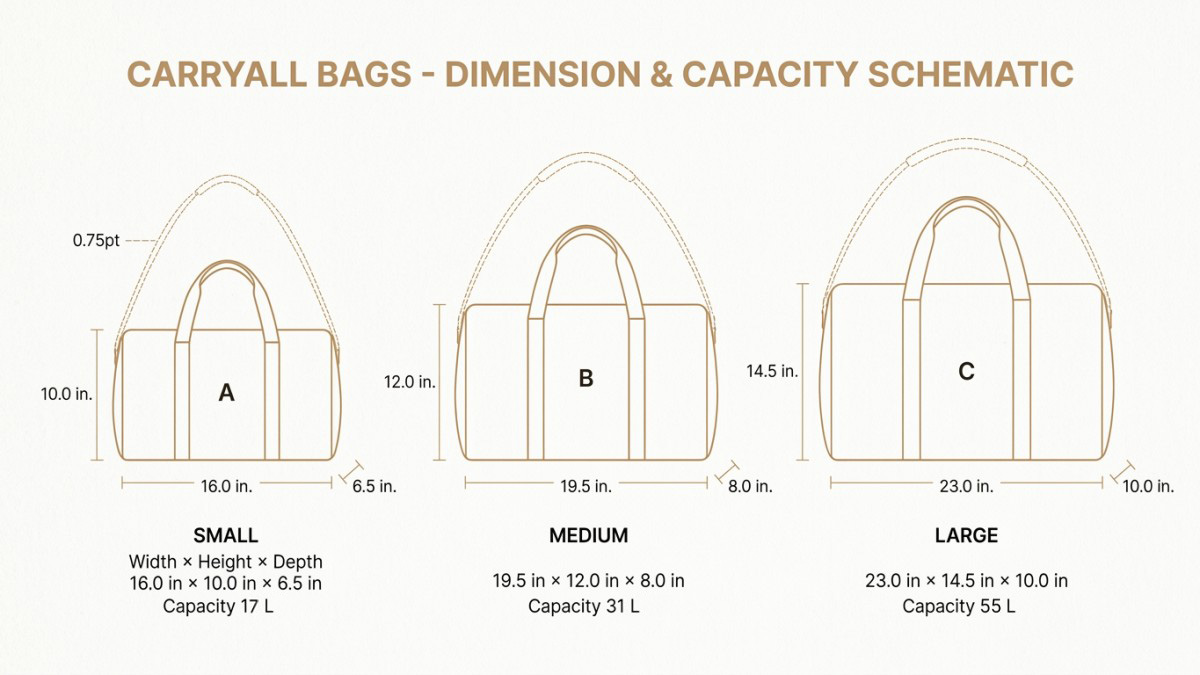
Size at a glance: Small, Medium, Large.
Construction varies more than the name suggests. Most are soft-sided or semi-structured — no rigid frame, but enough body to hold shape when loaded. Dual top handles are nearly universal, and a detachable or adjustable shoulder strap appears on the majority of medium-to-large versions. The strap isn't an afterthought; it's what separates a bag you can carry hands-free from one you're constantly juggling.
Closure tells you a lot about intended use. Open-top designs prioritize speed — grab and go, no fumbling. A zip closure signals security and travel readiness. A magnetic snap sits between the two: quick access with a degree of containment, common on fashion-forward styles. The OED traces "carryall" back to 1714, and that longevity tracks — the form has always adapted to what people actually need to carry, with closure and structure shifting to match the context.
The appeal of carryalls comes down to one simple fact: life rarely fits into a single category. A bag that handles Monday's laptop and gym kit, Thursday's beach run, and Saturday's overnight trip earns its place precisely because it doesn't specialize.
Think through the typical week. Office days call for a structured interior that keeps a notebook flat and a charger within reach. Gym sessions demand room for sneakers, a water bottle, and a change of clothes — no compromise. Weekend travel means consolidating two days into one bag without looking like you raided a storage unit. Beach trips need sand-resistant bulk capacity. Daily errands just need enough space, fast.
Carryalls absorb all of it. The silhouette stays deliberately open — wide mouth, soft structure, generous depth — because locking the shape down would lock the use case down too. That flexibility isn't a design oversight; it's the entire point. The bag adapts to the day, not the other way around. In practice, that versatility expresses itself across four distinct silhouettes — each with its own strengths.
Carryall Overlap: Tote, Hobo, Duffle & Heavy-Duty Tote Compared
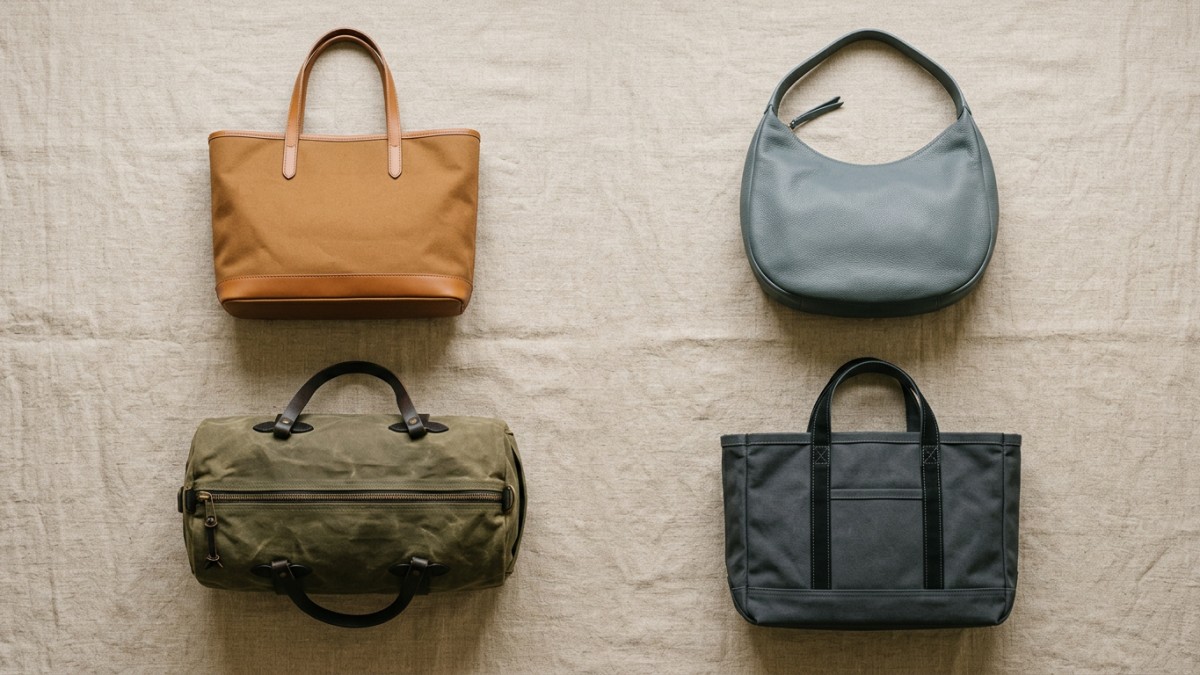
Four silhouettes, one function — how each style expresses carryall versatility.
| Style | Silhouette | Typical Capacity | Closure | Best Use | Carryall Overlap |
|---|---|---|---|---|---|
| Large Tote | Open, structured rectangle | 20–35L | Open top or magnetic snap | Office, market, daily carry | High — the default carryall expression |
| Hobo | Crescent, wider-than-tall, slouchy | 15–25L | Zip or drawstring | Casual daily, weekend errands | Strong — soft volume reads as carryall when scaled up |
| Duffle | Cylindrical or rectangular barrel | 30–60L | Full-length zip | Gym, overnight, travel | Moderate — capacity qualifies; structured shape limits crossover |
| Heavy-Duty Tote | Boxy, reinforced base, upright | 25–40L | Open top or zip | Worksite, grocery, utilitarian carry | Growing — increasingly adopted as a fashion-forward carryall |
None of these are locked subcategories. They're simply where carryall function tends to land in the real market.
The large tote is the most direct expression — open top, roomy interior, grab-and-go ergonomics. Most people picture this silhouette when they hear "carryall tote bag." But the category doesn't stop there.
Hobo-silhouette carryalls are a legitimate market form. Think wider than tall, a crescent-shaped body that pools toward the bottom, and a soft drape that reads as relaxed rather than structured. Louis Vuitton has produced hobo-format carryalls that sit squarely in this mold — proof that the carryall idea tolerates a slouchy build when the volume is there. The key isn't the frame; it's the carrying capacity and intent.
Duffle bags bring the clearest capacity credentials — barrel bodies that swallow a weekend's worth of gear — though their more athletic silhouette keeps them at the edge of the carryall conversation rather than the center.
The most interesting recent entrant is the heavy-duty tote. Originally a workhorse for grocery runs and jobsite hauls, it has recently moved into fashion territory as designers layered more refined details onto its utilitarian foundation. Thicker straps, riveted corners, cleaner proportions, and waterproof linings now appear alongside leather goods in retail assortments. For buyers focused on bags that bridge utility and lifestyle positioning, the heavy-duty tote sits comfortably within the carryall frame.
When a product listing says "carryall," that label alone tells you almost nothing. The word gets applied to totes, duffles, hobos, and oversized slouch bags alike. What actually confirms carryall intent is a cluster of structural and functional signals — the kind a sourcing team can scan in seconds.
Use this checklist when filtering SKUs or drafting a product brief:
That last point matters especially for leather carryalls. A well-constructed leather bag built for carry-all use should specify full-grain or top-grain construction — not bonded or split leather, which creases under load and cracks at stress points. Look for reinforced base panels and a silhouette structured enough to hold its shape when packed. A leather carryall that collapses into itself when loaded isn't doing its job.
For sourcing teams, running every candidate SKU against this checklist cuts through vague supplier descriptions fast. It also gives you the vocabulary to write tighter product briefs — ones that don't leave room for a factory to substitute a slouchy shopper when you needed something built for daily heavy use.
Start with the end use, not the label. A structured tote suits daily commuting or retail-floor carry — open access, flat base, shoulder-friendly. A hobo-style carryall works when the load is lighter and the aesthetic matters more than rigid organization. Duffle-shaped carryalls handle gym bags, overnight travel, or bulk sample transport where raw volume wins. Heavy-duty totes bridge the gap when you need a workhorse silhouette that still reads as fashion-forward.
Once the context is clear, three anchors narrow the field: capacity (how much, how dense), closure (security versus grab-and-go speed), and internal organization (one open cavity or compartmentalized). No label alone answers those questions.
For brands and retailers sourcing carryalls at scale, Milestone offers OEM and custom development across all these silhouettes — from material selection to hardware finish. Reach out to discuss your next line.
Ready to start your custom project?
Expert insights on care, styling, and manufacturing.
Most carryall bags qualify as carry-on luggage, provided they meet your airline's size limits (typically 22×14×9 inches). Structured styles with firm bases fit overhead bins well, while softer, oversized versions may only work as personal items. Always verify dimensions against your specific carrier's carry-on size rules before flying.
Carryalls and totes overlap but differ in structure and purpose. A carryall typically features a more rigid frame, multiple compartments, and a versatile design suited for travel or overnight use. A tote, by contrast, is usually open-top, unstructured, and designed for lighter everyday carrying needs.
Most carryall bags comfortably hold 10–20 lbs before handles show stress, though quality varies significantly by construction. Canvas or leather handles with reinforced stitching can manage heavier loads, while cheaper synthetic options may strain earlier. Always check the seams where handles attach — that's typically the first failure point.
Most carryall bags are not inherently waterproof, though many feature water-resistant coatings that handle light drizzle. For heavy rain, look for bags made from waxed canvas, coated nylon, or those with a waterproof lining. When in doubt, a simple rain cover or packing essentials in zip-lock bags adds reliable protection.
Canvas, ballistic nylon, and full-grain leather are the top choices for heavy daily use. Canvas resists abrasion and cleans easily, ballistic nylon offers exceptional tear resistance at a lighter weight, and full-grain leather develops character while maintaining structural integrity. Waxed cotton is a stylish mid-tier option with solid water resistance.